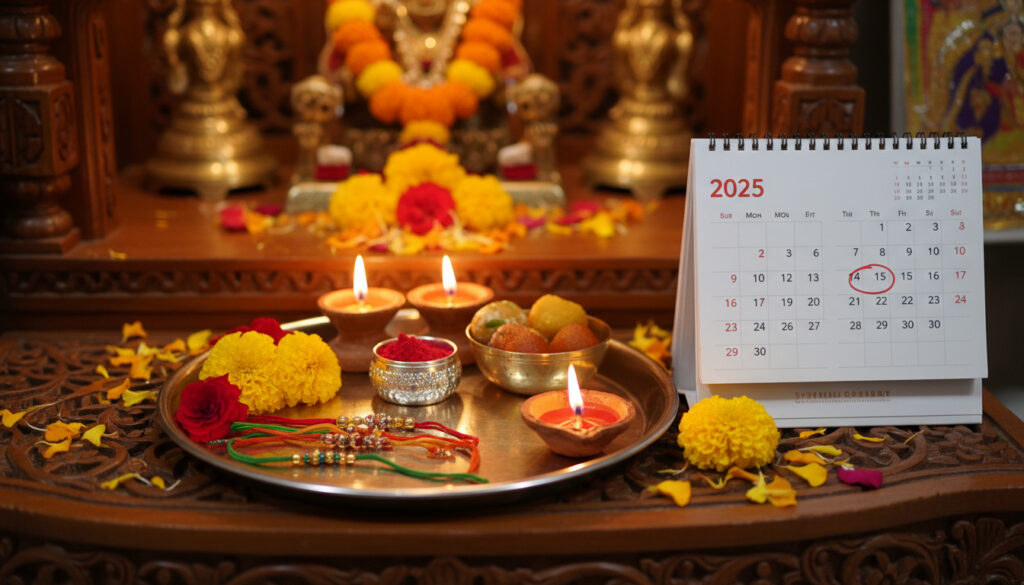
Raksha Bandhan 2025 – Date, Shubh Muhurat and Rituals Guide
Raksha Bandhan 2025 falls on Saturday, August 9, aligning with the full moon of Shravana Purnima. The festival anchors the Hindu lunar month of Shravan, when sisters tie sacred threads on their brothers’ wrists and brothers vow protection, reinforcing familial bonds across India and the global diaspora.
While the Purnima Tithi technically commences on August 8 between 2:12 PM and 3:42 PM, religious authorities uniformly recommend observing rituals on August 9. This timing accounts for Bhadra, an inauspicious period that ends early on Saturday morning, ensuring all ceremonies occur within auspicious parameters.
Markets in Delhi, Mumbai, and regional hubs have already begun stocking designer and eco-friendly rakhis, with preparations typically peaking one to two weeks before the festival. This year continues the trend of sustainable celebrations and virtual ceremonies for siblings separated by geography.
When is Raksha Bandhan 2025?
- Purnima Tithi begins August 8 between 2:12 PM and 3:42 PM
- Bhadra concludes at 1:52 AM on August 9, clearing the day for rituals
- Consensus among India Today and Economic Times confirms August 9 observance
- Thread ceremony window spans approximately 7-8 hours
- Observed as a bank holiday in Gujarat, Rajasthan, and Haryana
- Coincides with Sarvarth Siddhi Yog until 2:23 PM
| Aspect | Details |
|---|---|
| Festival Date | August 9, 2025 |
| Lunar Phase | Shravana Purnima (Full Moon) |
| Purnima Tithi Start | August 8, 2:12 PM – 3:42 PM |
| Purnima Tithi End | August 9, 1:24 PM – 2:54 PM |
| Bhadra End Time | August 9, 1:52 AM |
| Thread Ceremony Muhurat | 5:47 AM – 1:24 PM |
| Abhijit Muhurat | 12:02 PM – 12:50 PM |
| Calendar System | Hindu Lunar Calendar |
| Holiday Status | Regional bank holiday |
| Auspicious Yogas | Sarvarth Siddhi, Saubhagya |
Raksha Bandhan 2025 Shubh Muhurat and Timing
The optimal window for tying the rakhi centers on the morning and early afternoon of August 9. According to Drik Panchang, the Thread Ceremony Muhurat extends from 5:47 AM until 1:24 PM, providing an eight-hour window for ceremonies.
Aparahna and Abhijit Periods
Aparahna Muhurat, considered highly favorable for rakhi tying, occurs between 1:41 PM and 2:54 PM according to NDTV, though Drik Panchang extends this window until 4:51 PM. The Abhijit Muhurat, another potent period, runs from 12:02 PM to 12:50 PM.
City-Specific Considerations
Timings remain consistent across Delhi, Mumbai, and other Indian cities when following Indian Standard Time. Hindustan Times notes that while local panchangs may display variations, the Ujjain-based calculations from Drik Panchang provide reliable pan-India defaults.
Bhadra, an inauspicious period, concludes at 1:52 AM on August 9, well before sunrise. This early conclusion makes the entire daylight period safe for rakhi ceremonies, unlike previous years when Bhadra extended into daylight hours.
Significance and History of Raksha Bandhan
The festival encapsulates the principle of raksha—protection—woven into the sacred sibling relationship. Sisters tie a consecrated thread while reciting prayers for their brothers’ prosperity; brothers respond with vows of guardianship and gifts, creating a reciprocal bond of duty and affection.
Mythological Origins
Hindu tradition preserves multiple origin stories. The narrative of Draupadi and Krishna remains prominent, where Krishna, injured, had his bleeding finger bound by Draupadi’s sari fragment, prompting a divine promise of protection. Another account describes the river goddess Yamuna tying a thread to her brother Yama, securing immortality and establishing the festival’s sanctity.
Contemporary Meaning
Modern observances extend beyond biological siblings to include cousins, close friends, and symbolic relationships, reflecting evolving family structures. The festival now encompasses broader themes of mutual respect and care within communities.
How to Celebrate Raksha Bandhan 2025
Traditional Ritual Steps
The ceremony follows a precise sequence. The sister prepares a thali containing the rakhi, vermilion (roli or tilak), rice grains, and sweets. She applies the tilak to her brother’s forehead, ties the rakhi while chanting mantras, performs aarti, and offers sweets. The brother reciprocates with tilak, presents gifts, and pledges protection. Moneycontrol notes that some families incorporate full puja vidhi with kalash and specific chants.
Preparations and Shopping
Families typically initiate preparations seven to fourteen days in advance. Markets in Chandni Chowk, Delhi, and South Mumbai witness peak traffic for designer rakhis, traditional sweets like soan papdi and modak, and ceremonial thalis. Retail observations indicate sustained demand for both traditional handcrafted rakhis and contemporary variations.
Emerging Trends
Sustainability dominates current trends, with bamboo and seed-embedded rakhis gaining traction among environmentally conscious consumers. Digital rakhis and virtual ceremonies accommodate non-resident siblings, while ritual adaptations include rakhis tied to armed forces personnel and healthcare workers, expanding the protection theme beyond familial bounds.
Eco-conscious celebrants increasingly choose plantable rakhis embedded with seeds or crafted from biodegradable materials. These options reduce post-festival waste while symbolizing growth and renewal within the sibling relationship.
Ceremonies conducted during Bhadra—ending at 1:52 AM on August 9—are considered inauspicious. While the August 8 afternoon marks the technical start of Purnima, waiting until August 9 morning ensures alignment with favorable astrological conditions.
Raksha Bandhan 2025 Wishes and Messages
Exchanging blessings forms an integral component of the festival, with messages delivered through cards, digital platforms, and verbal exchanges. Traditional Hindi formulations emphasize the sacred bond and protection vows, while English greetings often focus on enduring affection.
Common Hindi expressions include: “Bhaiya ke haathon mein rakhi bandhna, unki raksha ka vachan lena. Raksha Bandhan ki hardik shubhkamnayein!” and “Rakhi ke is pawan tyohaar par, bhai-behen ka pyar badhe.” English speakers frequently exchange sentiments such as “May this Rakhi strengthen our bond forever” and “Wishing you a Raksha Bandhan filled with love and protection.”
Timeline of Recent Raksha Bandhan Observances
- 2023: Observed on August 30-31, depending on regional panchang calculations and Bhadra timing.
- 2024: Celebrated on August 19, maintaining the Shravan Purnima alignment.
- August 2025: Purnima Tithi begins August 8 afternoon; Bhadra clears by 1:52 AM on August 9; main observance on August 9.
- August 9 Morning: Thread Ceremony Muhurat opens at 5:47 AM.
- August 9 Afternoon: Aparahna Muhurat extends through early afternoon, concluding before Purnima Tithi ends.
What is Definitively Known and What Varies
| Established Facts | Uncertain or Variable Elements |
|---|---|
| August 9, 2025 is the consensus observance date | Exact minute of Purnima Tithi start varies between 2:12 PM and 3:42 PM depending on source |
| Bhadra concludes at 1:52 AM on August 9 | Specific Aparahna end time varies (2:54 PM vs 4:51 PM) |
| Thread ceremony spans morning to early afternoon | Holiday declarations vary by state (confirmed for Gujarat, Rajasthan, Haryana; others unverified) |
| Pan-India timings follow IST consistently | Individual family traditions regarding specific mantras or additional deities |
Cultural Context and Contemporary Relevance
Raksha Bandhan operates as a structural mechanism for reaffirming kinship obligations within Hindu families and the broader South Asian diaspora. The festival’s placement during Shravan—a month dedicated to Lord Shiva—amplifies its spiritual resonance, connecting domestic rituals with larger religious cycles.
Contemporary celebrations reflect demographic shifts. Non-resident Indians utilize courier services and video calls to maintain ritual continuity, while urban Indian families increasingly integrate eco-conscious materials and gender-inclusive interpretations. The core architecture—protection exchanged for care—remains intact even as surface expressions adapt to modern constraints.
Sources and Historical References
“Bhaiya ke haathon mein rakhi bandhna, unki raksha ka vachan lena. Raksha Bandhan ki hardik shubhkamnayein!”
Traditional Hindi blessing, as documented in India Today festival coverage
“May this Rakhi strengthen our bond forever. Happy Raksha Bandhan!”
Contemporary English greeting, synthesized from NDTV cultural reporting
Summary
Raksha Bandhan 2025 occurs on Saturday, August 9, following the conclusion of Bhadra at 1:52 AM. The primary muhurat for tying rakhis extends from early morning through early afternoon, with specific favorable periods including Abhijit and Aparahna. Families should prepare for traditional rituals involving tilak, sacred threads, and reciprocal vows, while remaining mindful of regional holiday schedules and sustainable celebration options.
Frequently Asked Questions
Is Raksha Bandhan a public holiday in 2025?
Raksha Bandhan functions as a bank holiday in several Indian states including Gujarat, Rajasthan, and Haryana. It does not carry nationwide gazetted status comparable to Diwali, resulting in regional variation in school and office closures.
How does Raksha Bandhan differ from Bhai Dooj?
Both festivals celebrate sibling bonds, but Raksha Bandhan occurs during Shravan Purnima (August) while Bhai Dooj follows Diwali in Kartika month (October/November). Raksha Bandhan centers on the sister tying a protective thread; Bhai Dooj involves sisters applying tilak and brothers offering gifts.
Can rakhi be tied on August 8, 2025?
While Purnima Tithi technically begins on August 8 afternoon, religious authorities advise against August 8 observance due to Bhadra. The inauspicious period extends into the night, making August 9 the appropriate date for all ceremonies.
Do muhurat timings differ between Delhi and Mumbai?
No. Both cities operate under Indian Standard Time, resulting in identical muhurat calculations. Local panchangs may reference Ujjain-based calculations, but the ceremonial windows remain synchronized across both metropolitan areas.
What constitutes proper rakhi preparation?
Essential items include the rakhi thread, roli or kumkum for tilak, rice grains (akshat), sweets (mithai), and a decorative thali. Many families additionally prepare specific brother-preferred dishes and acquire gifts in advance of the ceremony.
Are virtual rakhis considered valid?
Virtual ceremonies, where siblings connect via video call while siblings tie rakhis locally or send them via courier, have gained widespread acceptance. The ritual’s efficacy depends on intent and familial acknowledgment rather than physical co-presence.
More related posts
 Car Sales Brisbane – Top Dealers, Prices and Locations
 Programmed Skilled Workforce – Operations, Scale and Importance
 Baltimore Ravens vs Bengals Match Player Stats – 2024 Box Scores and Leaders
 Urea Breath Test – Procedure, Accuracy and Results
 American Tourister Luggage – 2025 Review, Best Models and Guide